Let’s discuss, let’s argue
Structural Classification and Notation of Units of Motor Activity in Weightlifting
English summary of Tyazhelaya Atletika. Ezhegodnik 1985 (Moscow: Fizkultura i Sport, 1985), pp. 46–53: the text is paraphrased, not translated; data tables are given in full with English labels; figures are the original images.
Sports practice is approaching a system of preparation comparable to a technological process, built from many hierarchically organised components. Their motor manifestations hold the central place, and classifying them is the starting task in every sport. A review of earlier work on barbell exercises (N. I. Luchkin, 1952; L. N. Sokolov, 1967) shows that its solutions no longer meet present needs, while methodological groundwork of the last decade allows a fresh approach.
That approach was developed by one of the authors, K. Yu. Danilov (1978, 1980, 1981, 1983). It separates two problems: identifying the structure of the object studied, and devising a teaching method. The first is basic to the second and is treated here. It became solvable once sports activity could be modelled as a hierarchical system of four levels.
The four levels
A language offers an analogy: its alphabet (level 1), words and their formation rules (level 2), sentences and their construction (level 3), and the ways sentences are joined into a work with complete meaning (level 4). One cannot analyse "language in general" while confusing letters with sentences, yet the analysis of motor activity does just that, because its "letters", "words" and "sentences" have not been singled out.
Level 1 consists of single-link movements. Level 2 holds the smallest complete motor manifestations of the organism in its environment, which break down into postures and displacements; with starting and end positions, direction of travel and other features they form the set of units of motor activity. Level 3 comprises concrete actions made up of level-2 units combined by a common goal, plus the "connections" linking units, not considered here. Level 4 covers each kind of sport and adds the social interactions characteristic of it. For every sport the main task is thus to identify the units of level 2.
Units of the lifts
In weightlifting not only the athlete's body moves but the "athlete-barbell" system, and the aim is to bring the barbell to a certain position in space, the body's movements being subordinate. So in the snatch and the clean and jerk, units should be isolated by their displacement effect on the barbell. Figures 1 and 2 give block diagrams for the two lifts; we discuss only the second.
In competition the lifter moves an individually maximal weight through a combination of three linked kinds of movement of the implement: up, down, and held motionless. On this basis 13 units can be distinguished in the two-arm clean and jerk. The actions in the starting position and preliminary start, before the barbell leaves the platform, have a specific structure and will be treated separately.
Unit 1 is the barbell's rise from the platform to the end of the pull, where the lifter starts to go under it: "raising the barbell until the athlete begins to drop into the squat". Unit 2 is the barbell's downward travel from that point to where it practically stops after the athlete gets under it: "the athlete's drop into the squat when lifting the barbell to the chest". Unit 3 is the upward travel of barbell and athlete as he rises: "rising from the squat with the barbell on the chest". The rest are clear from Fig. 2.
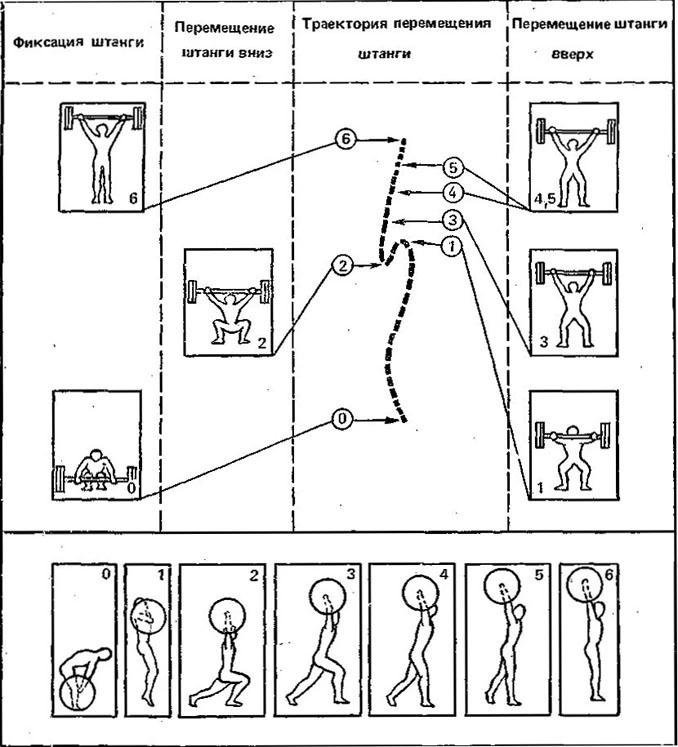
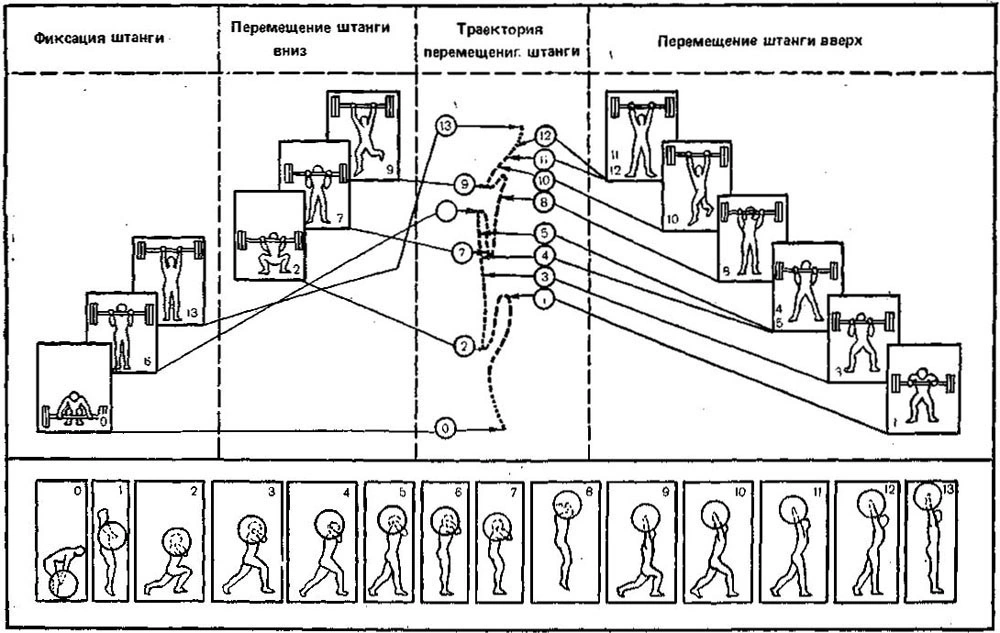
Classes and variants of units
The units follow one another in the competition lift. In teaching, the lift is mastered by part and whole methods, and the literature notes that learning goes better when components are practised separately, stressing the most significant movements; variants of components and special assistance exercises, devised purely empirically, also help. Analysing the structure of units should make it possible to derive every theoretically possible variety and set them out in order, which would greatly ease teaching and training.
This requires the structural elements of a unit: starting positions, directions of movement, quantitative characteristic and end positions. In weightlifting the quantitative characteristic is the mass lifted. A maximal weight and a fraction of it serve different purposes, but the spatial and temporal characteristics stay close even though forces differ greatly, so such units belong to one class. Movement of the "athlete-barbell" system makes starting and end positions far more complex; Fig. 3 shows the hierarchical "tree" of starting positions. Its second level records the positions of athlete and barbell, the next those of body parts (arms, trunk, legs) and of the barbell (overhead on straight arms, above, at or below shoulder level), with further subdivision as drawn. This multi-level content explains the multiplicity of unit variants.
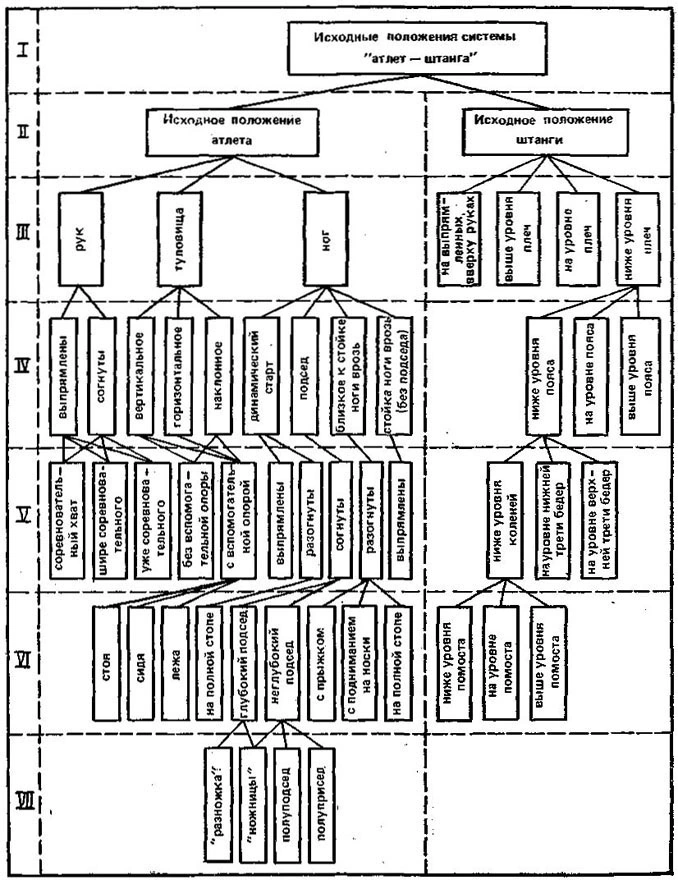
Direction of movement applies only to the barbell and has a single value within each unit: up, down or held. A clean and jerk combination could be performed in reverse order, each unit's direction then being opposite; the rules fix direction in competition, but training may use the opposite. Of the four features, only starting and end positions differentiate units, so matrices can be built showing every unit within a class.
The matrices
Describing the actions in the starting position (kinds of preliminary start), the 6 units of the snatch and the 13 of the clean and jerk took 9 matrices; the second serves as an example (see the table). Starting positions form the head and end positions the right side, each in strict order. The barbell may start above, at or below shoulder level, the last splitting into above, at and below waist level, and so on down to the platform, giving nine columns. Trunk and arm positions are auxiliary and omitted here, and the legs are straight in every column. End positions give eight rows. Where a combination of row and column is practically possible, a variant of the unit arises: a cross marks it, and a square marks one common in practice.
The matrices set out all combinations in orderly, exhaustive form, which verbal description could hardly match, and help coach and athlete grasp how units arise and choose those needed for teaching and training.
Table. Matrix 2: starting and end positions of the "athlete-barbell" system
| Starting positions of the "athlete-barbell" system | End positions of the "athlete-barbell" system | |||||||||
| below shoulder level | at shoulder level | above shoulder level | ||||||||
| below waist level | at waist level | above waist level | ||||||||
| below knee level | at lower third of thighs | at upper third of thighs | ||||||||
| below platform level | at platform level | above platform level | ||||||||
| 1 | 2 | 3 | 4 | 5 | 6 | 7 | 8 | 9 | ||
| ■ | ■ | + | — | — | — | — | — | — | 1 | Below knee level |
| + | + | + | — | — | — | — | — | — | 2 | At lower third of thighs |
| + | + | + | + | — | — | — | — | — | 3 | At upper third of thighs |
| ■ | ■ | + | ■ | + | — | — | — | — | 4 | At waist level |
| + | ■ | + | + | + | + | — | — | — | 5 | Above waist level |
| + | + | + | + | + | + | + | — | — | 6 | At shoulder level |
| + | + | + | + | ■ | + | + | + | — | 7 | Above shoulder level |
| + | ■ | + | + | + | + | + | + | + | 8 | Overhead, arms straight |
Notes: 1. In all starting and end positions the athlete's legs are straight. 2. Key: + possible variant; ■ variant most common in practice; — variant impossible.
Notation
The classification allows verbal terminology to give way to alphanumeric coding of units and combinations (K. Yu. Danilov, 1983), on two principles: structural features always take fixed digits and letters, and these form a number in which position matters as well as value. Each unit has its own number of one or two parts separated by a dash, the first giving main and the second additional characteristics.
The main part has three digits: the matrix number (1 to 9); the starting position of the system (at most 9 per matrix, given in the bottom row of the matrix head); and the end position (likewise at most 9, given in the leftmost column). The range is thus 111 to 999.
Unit 244 reads: "2", the second matrix, barbell lifts before the athlete drops under; "4", starting position at the lower third of the thighs; "4", end position at waist level. It is the pull from the lower third of the thighs to the waist (from blocks), whereas a pull from the platform to waist level is 224. In a combination, numbers are separated by commas, with a full stop after the last. Like any specialised system, this one takes some practice.