Training methods and planning
The Weightlifter's Pre-Competition Warm-Up
English summary of Tyazhelaya Atletika. Ezhegodnik 1985 (Moscow: Fizkultura i Sport, 1985), pp. 30–33: the text is paraphrased, not translated; figures are the original images.
A warm-up prepares the body for heavy loads on the locomotor apparatus. Besides general autonomic changes, it raises lability in the motor apparatus, establishes isochronism of muscles and nerves and speeds up biochemical processes. Just as important is the rise in body temperature: warm muscles have open capillaries, lower viscosity and greater elasticity, which guards against injury.
The author feels that manuals treat the subject too thinly, so warm-ups are often far from perfect. Despite rising results, lifters still fail at competitions, and a poor warm-up is in his view one cause of the so-called zero scores. He timed the warm-ups of lifters at USSR competitions in 1970–1980, the 1975 World Championships and the Friendship Cups of 1975, 1976 and 1979, and recorded the main work that followed; he also ran a postal questionnaire among 63 lifters (35 Masters and Merited Masters of Sport, 13 first-class lifters and candidates for Master, 15 second-class lifters). Of these, 79.5% had failed in the first two attempts at contests, and 44% of them blamed an inadequate warm-up; 46% attributed muscle strains to insufficient warming up. Yet respondents' views on structuring a warm-up were contradictory.
Warm-ups differ in length, intensity, rest before the main work and choice of exercises. Electrothermometry (over 700 readings in various muscle groups of 133 lifters of different classes) showed that each scheme prepares the apparatus differently. After a forced warm-up of fast, mostly stretching exercises, the skin temperature over the working muscles rose only 0.2–0.5° (Fig. 1) and sometimes fell. After a warm-up of dynamic exercises at a moderate tempo, with no stretching in the preparatory part, it rose 1.2–1.5°.
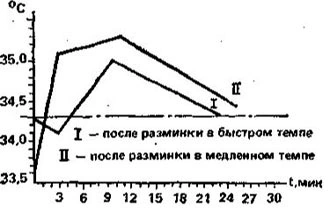
Readiness also comes only 5–8 minutes after the general warm-up ends, a criterion that matters above all at contests. Over ten years the author saw many lifters do a short general warm-up, or none, and go straight to the classic lifts; they force the settling-in and make many errors, because coordination has not yet reached the level a quality lift demands.
Most authors agree that a warm-up must include exercises imitating the main work. Yakovlev, Korobkov and Yananis (1957) explain that a temporary connection forms between the conditioned reflexes behind such exercises and the main skill, so they stimulate the connections underlying the coming lift indirectly. In practice most lifters use only the classic lifts. For the snatch the special exercises most often used are the snatch into a high squat, the half-squat and the snatch-grip squat with the bar at arm's length overhead; for the clean and jerk, the clean into a high squat, front squats and the push press, though in the jerk lifters more often start with none at all, which does not always keep the lift stable. Abadzhiev and Furnadzhiev (1974) stress that a lift needs the finest coordination, with effort concentrated in the active phases and relaxation in the passive one; special exercises should let the lifter feel the weight in each phase, and only then should the whole lift follow. On this basis, and on his thermometric, timing and questionnaire data, the author proposes the method below.
Warm-up for the snatch
General warm-up begins 25–30 minutes before the platform; at up to 2 minutes per attempt that is 13–15 attempts ahead, adjusted for the scale of the contest. Start with slow running (up to 1 minute), then 5–6 exercises for different muscle groups at a moderate tempo, 8–12 repetitions each, then 3–4 exercises with a plate or bar:
- from the starting position, raise the plate along the body to straight arms, 6–8 times;
- half-bends with the plate behind the head, 5–6 times;
- feet in the split or scissor snatch stance, elbows raised, plate behind the head: straighten the arms and sink into the snatch squat, 4–5 times at a moderate tempo.
After 6–8 minutes the muscles feel warm, and only then does the special warm-up begin, 18–23 minutes (9–12 attempts) before the platform:
- a bar of 25–30% of the best snatch is raised to straight arms in the snatch grip and lowered behind the head; pressing it out, sink into the snatch squat, 3–4 times, each squat lower and crisper, until the low squat is firmly fixed;
- 35–40%: snatch into a high squat, lower behind the head, drop under with minimal drive and active pressure on the bar, 3–4 times; then lower the bar to the lower third of the thighs for 1–2 hang snatches;
- 50–60%: snatch pull stopped at the lower third of the thighs, then a half-squat snatch and a hang snatch with rocking in the low squat;
- 7–10 attempts before the platform, the classic snatch: 6–8 attempts, the first two with 1–2 lifts, the rest with 1.
At a long contest the first two exercises can be done in 2–3 attempts.
Warm-up for the clean and jerk
The start depends on the pause after the last snatch attempt. After more than 30 minutes, do 3–4 exercises with a weight 20–25 minutes (12–15 attempts) before the platform; after 30 minutes or less, begin the special part 18–23 minutes (10–12 attempts) before:
- 40–50%: clean pull stopped just above the knees, clean into a half-squat, 1–2 front squats, 2–3 jerks with a press-out, watching the starting position, the emphatic upward thrust and the crisp use of the arms;
- 50–60%: clean into a half-squat, from knee level into a squat, one press-out jerk, 1–2 classic jerks;
- the classic jerk in 5–6 attempts, one lift each.
Athletes who start early, or whose contest drags on, sometimes take 12–13 attempts, repeating the last weight or starting over. Instead, plan a reserve weight, so that 2–3 or more attempts can be made cheaply if the call is delayed. The final attempt belongs only 2–4 minutes before the platform; a longer interval breaks the rhythm built by years of training.
Waiting for a call, lifters often do much snatching or jerking so as not to cool. But the temperature over the working muscle, once at its maximum, holds for 10–15 minutes or more, and far longer with warming rubs or ointments. The point is to keep the habitual rhythm: imitate single phases of the lift or do a pull, preferably only its first phase. If the break lasts 15–20 minutes, do the classic lift in 2–3 attempts before the next competition attempt.
Practice shows that such a warm-up markedly cuts failed lifts and greatly reduces injuries to the locomotor apparatus, still common in weightlifting.