Technique of weightlifting exercises
The Position of the Barbell and of Certain Main Body Segments at the Start
English summary of Tyazhelaya Atletika. Ezhegodnik 1985 (Moscow: Fizkultura i Sport, 1985), pp. 22–24: the text is paraphrased, not translated; figures are the original images.
The bar’s path in the snatch and in the clean for the jerk is among the best-studied elements of technique, yet those who measured it (R. A. Roman and M. S. Shakirzyanov, 1978, 1980, and others) did not ask why its elements vary so much. V. P. Agudin (1972) linked the path to the weight and to the lifter’s height and skill, but did not analyse variability among equally skilled lifters at 100%. The bar should travel as close to the body as possible, so that less force is needed; yet the literature describes paths in which it drifts away from the initial vertical through its centre.
Researchers now hold that the start vertical should pass through the bar’s centre and the feet be set so that the centre of the metatarsophalangeal joints (MPJ) lies on it. But cine and photographic observation shows that most lifters place their feet farther from the bar and still achieve high results. The authors therefore propose drawing the vertical through the MPJ centres and locating the bar centre and body segments, above all the shoulder joints, relative to it, which compares paths more objectively.
The posture at the moment the bar leaves the platform (MBL) strongly influences the path. Highly skilled lifters then hold the shoulder joints ahead of the vertical, most of all those of brachymorphic build. An angle forms between the vertical and the arms, so the lifter must apply force that draws the bar toward the legs; otherwise it moves forward and the lift becomes hard. Many top lifters intuitively draw the bar in strongly and quickly, so that within a few centimetres it is on the optimal path, even though at the MBL it was farther out than the MPJ vertical.
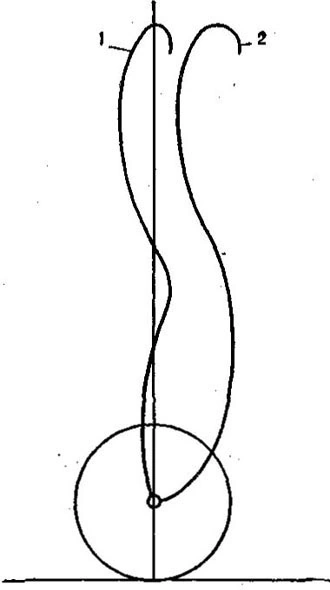
Yu. Vardanyan is an example (Fig. 1). He puts the bar over his toes, but after the MBL an energetic effort sends it toward his legs, making up for the distant feet, so it rises closer to the body than for most. His dolichomorphic build justifies this: such lifters have a much smaller shank inclination, especially in the snatch, and cannot all put the bar over the MPJ vertical. Many lifters also flex and extend the knees before the MBL (“rocking”), which often leads them to set the feet farther away.
So the path depends on the starting movements, body type, the exercise and the ability to bring the bar to the legs right after the MBL, while foot position matters less. Lifters should train this skill consciously; the force needed is about 20–25 kg for a 200 kg bar. The most effective exercise is the bent-over pull until the legs are straight, the trunk not fully erect, touching the legs with the bar at the groin.
In conclusion:
- At and after the start the legs move the bar vertically up and the straight arms bring it toward the legs, from the MBL to the end of the pull.
- Brachymorphic lifters should attend more to this from the MBL.
- The feet may be placed somewhat farther from the bar than was thought possible, especially by dolichomorphic lifters.